
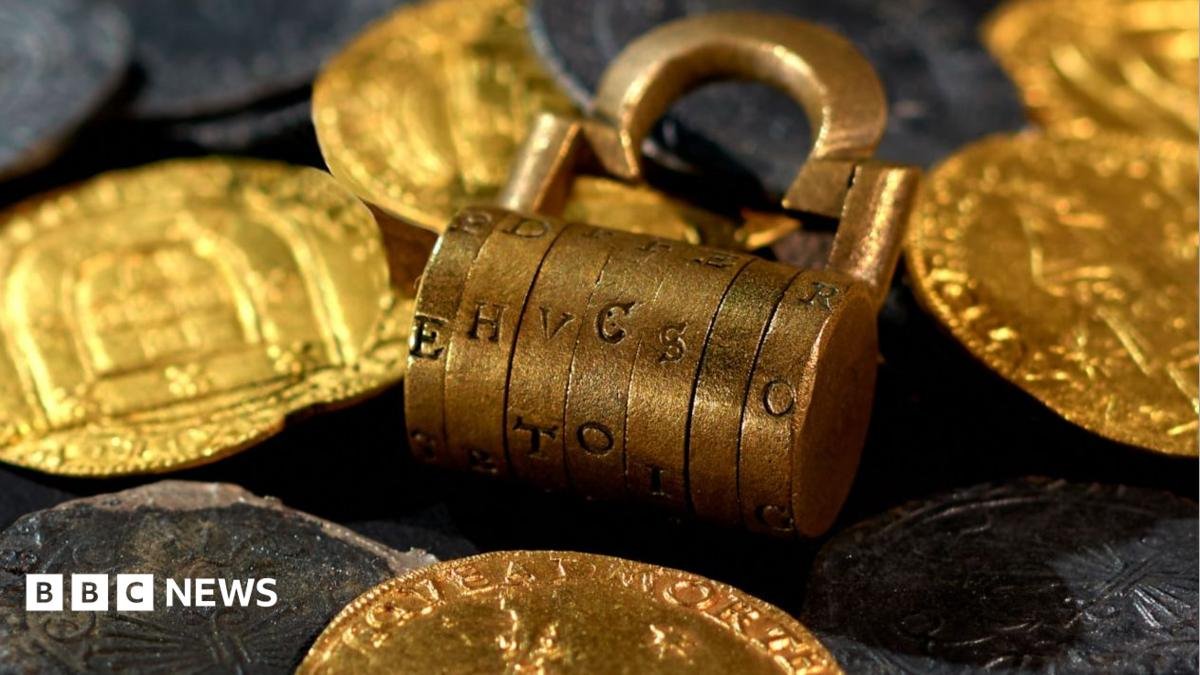
In a remarkable blend of history and technology, experts have finally cracked the four-letter code of a 400-year-old brass padlock recovered from a shipwreck off the Welsh coast. The lock, dating back to 1583, was discovered by metal detectorist Peter Hughes in 1999 near Margam in Port Talbot. It is part of a treasure hoard from the Ann Francis, a ship that sank during a storm on 28 December 1583 while returning from Spain.
A Chance Discovery
Peter Hughes, 69, from Maesteg, stumbled upon the lock along with coins and other artefacts during a day off, walking along Morfa beach with his metal detector. "It was by chance - a day off. I was walking along the beach with my metal detector on a day off, and I came across a coin," he said. "That was the start of a journey that lasted 21 years." The padlock was found near a collection of Spanish silver coins and coin weights, suggesting it may have protected valuable items such as documents or textiles that have since perished.
Hughes attempted to unlock the padlock for two decades, trying various combinations without success. "I tried to unlock it for about 20 years, I tried moving the dials, finding the right combinations, and I failed," he admitted. "But with the aid of modern technology we've been able to crack what's like the Da Vinci code, really. For me, it's like opening the Ark of the Covenant, and I'm delighted, truly thrilled."
Modern Technology Solves the Puzzle
The breakthrough came when experts at Amgueddfa Cymru and Cardiff University used CT scanning to examine the lock's internal mechanism. Dr David Williams, a research associate at Cardiff University's School of Engineering, was initially sceptical about the task. "It's challenging, the device we have is not designed to this particular purpose," he explained. "This is micro CT scanning, something you'd get at the hospital, but for smaller items." Despite the odds, Williams and his team persevered. "We did a first scan to see if we could see anything and we were quite surprised that we could see letters," he said. "The second scan went terribly, but with the third scan, we tried a different approach, and figured out the code. I was blown away that we actually cracked it."
The code spells out ANCE, and the inside of the lock resembles a key. Senior curator Alastair Willis described the complexity of the lock: "It's really complex because there are so many combinations. There are four different rings, and because there are six different letters on each of the rings, there are 1,296 different combinations, and you have to make sure they're aligned with the loop at the top."
A Glimpse into the Past
Siân Iles, another senior curator at Amgueddfa Cymru, noted the lock's excellent condition. "This is a wonderful example of one that still functions as it would have done hundreds of years ago," she said. "Because it was found so close to the wreck of the Ann Francis and with all the material that's part of that collection, it provides a really good context, it allows us to really tightly date it." She added, "I've seen others, and they're usually corroded and in different parts, but it was in wonderful condition. It's a small object so it probably would have been a lock for a chest or a small box, we don't know the content, and that's part of the story, there are some things we'll never know, but it's something that would have meant something to the person who knew that code."
The hoard was passed on to Amgueddfa Cymru in 2017, and the collection, with the lock as its centrepiece, went on display at Swansea Waterfront Museum in July 2026. The padlock's code, now revealed, offers a tangible connection to the past and highlights the importance of preserving underwater heritage.