
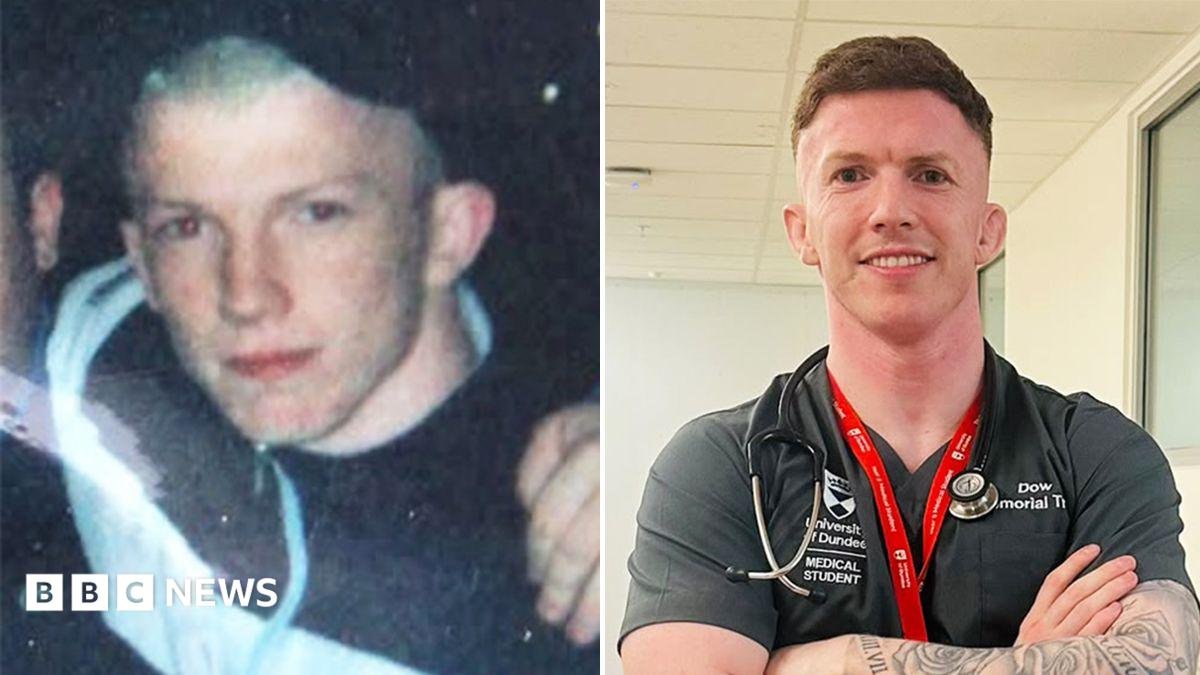
Steven Beattie's journey from a young offender to a junior doctor is a testament to the power of determination and self-reflection. Growing up in the Hillington area of south-west Glasgow, Steven faced immense challenges at home. His father suffered from Parkinson's disease, and his mother was diagnosed with paranoid schizophrenia and later cancer, which claimed her life. As a young carer for both parents, Steven's teenage years were fraught with stress and responsibility.
A Troubled Path
Leaving school at 15, Steven found himself drawn into gang violence, which was rampant in his community during the 1990s and early 2000s. His involvement with gangs led to multiple stints in Polmont young offenders' institution, once described as "the most violent prison in Scotland." He was first sent there at 16 after drunkenly crashing a stolen car, and he returned repeatedly over the next four years as his involvement with gangs and violence escalated.
For Steven, the turning point came when he was punished for his part in a fight by being locked up for 23 hours a day and having his TV removed. "I never really had time to sit down and think where my life was going," he told the BBC's Scotcast podcast. "When they took my telly, I finally had that opportunity." He asked himself: if he kept doing what he was doing, where would he be in five years' time? "If I don't like that destination, I'll have to change it," he says.
A New Beginning
Steven admits it wasn't easy for a young offender to start a new life, but after years of effort, he's about to graduate as a junior doctor from the University of Dundee Medical School in June. Now 37, Steven wrote down three things he had to do: leave Glasgow, quit drinking, and stop hanging around people who got into trouble. He started his own personal training business, which gave him the ability to save up and move out of Glasgow. He is also an award-winning MMA fighter known as 'Doctor Beatdown'.
But his long-term goal was to become a doctor. He had been inspired by his dad's neurologist, who had noticed how much Steven was able to understand about his father's Parkinson's. His school grades were not enough to get him into medical school, so he attended an access course at Glasgow Kelvin College to study physiology at the University of Glasgow. That then got him into medical school, and in June, he'll graduate as a junior doctor. He hopes to specialise in either surgery, neurology or emergency medicine.
Reflecting on the System
Polmont was back in the news last week when it emerged it had recently experienced the worst prison rioting in decades. Prison officers from four other jails were called in to restore control during the incident, which involved about 30 inmates. Linda Pollock, chief executive of the Scottish Prison Service (SPS), said it was an example of "bubbling tension" caused by increasing overcrowding.
Steven says overcrowding can add to pressure inside prison. "Especially in terms of rehabilitation," he says. "The staff just no longer have the capacity to give attention to individual prisoners." He says a lack of attention can make inmates feel they're being left behind and unsupported. Without support they are unlikely to move on with life after prison, he says.
Steven says his teenage experiences have made him more determined to enjoy the chances he has now. "I think I've got an appreciation for life that a lot of people don't have because I know how bad it can get," he says.