
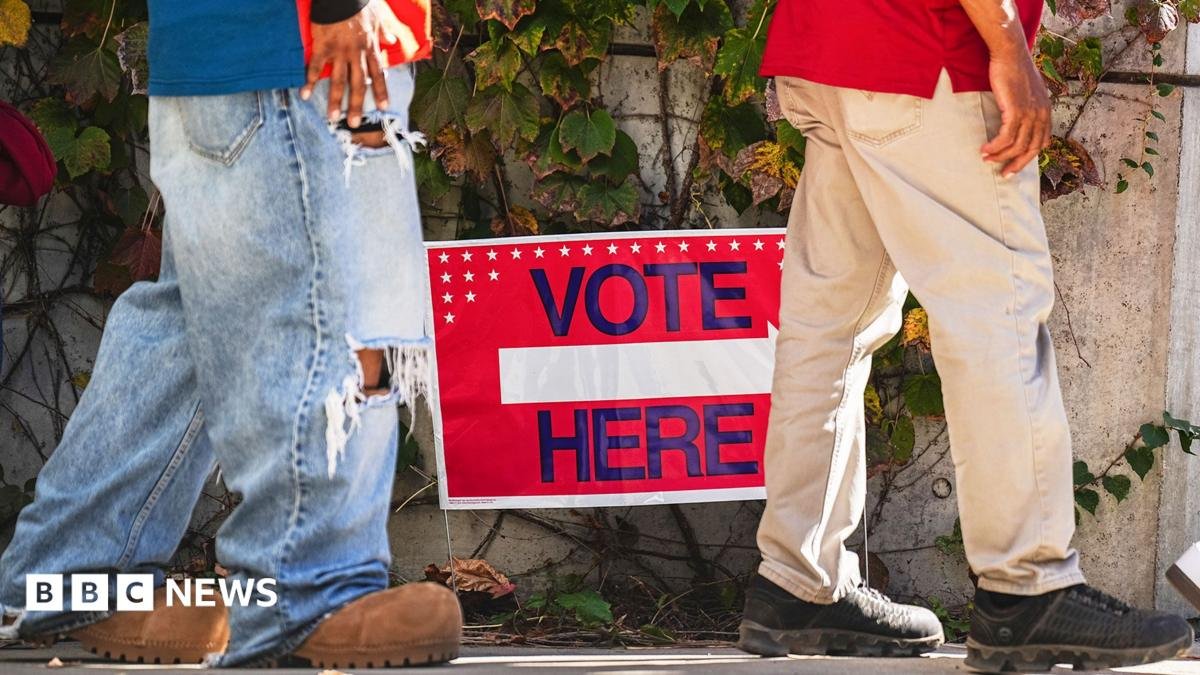
After months of intense campaigning and billions of dollars spent, election day for the US midterms has finally arrived. The latest public opinion surveys suggest Democrats have the upper hand, but polls have not always been reliable, and this year could bring its own surprises. Broadly speaking, there are three possible outcomes once Americans cast their votes. Here is a look at what they could be, what early signs might indicate as results come in, and what each could mean for the country.
\n\nA Democratic Wave
\nIf history is any guide, midterm elections tend to favor the party out of power. Add in what polls suggest is a historically unpopular president, a war with Iran that has driven up consumer costs, and controversial policies like aggressive immigration enforcement and support for data center construction, and the conditions for a so-called electoral wave are ripe. In this first scenario, a huge wave is exactly what happens.
\nDemocrats could not only take control of the House of Representatives but far surpass the 218 seats needed for a majority. They might win not only the dozen or so races that election analysts rate as too-close-to-call, but also flip some seats in more solidly conservative terrain. In the Senate, this scenario would require Democrats to win all or most of the current toss-up races, including some in traditionally conservative states. There would be at least one eye-popping victory in a place that hasn't elected a Democrat in a generation, Texas, or in nearly a century in the case of Kansas.
\nIf this did happen, Democrats would not just take control of the Senate, they would do so with a seat or two to spare. This might avoid any drama around a potential legal challenge by Republicans in Alaska, where a judge dismissed a Trump administration lawsuit over two Dan Sullivans being on the ballot. Democrats might accomplish this by boosting turnout of their voters and winning independent voters by sizable margins. This would reverse Trump's 2024 inroads with Hispanic voters and young men. Some Republican voters might also support the Democrats or just stay home.
\nThis kind of result would represent a stinging rebuke for Trump and his Republican Party, setting up two years of conflict between a newly invigorated Democratic Party with its hands firmly on the lever of legislative power and a president who seldom backs away from a fight. If Democrats hold targeted House contests in Florida and win some Republican districts in North Carolina, Michigan, New York, Virginia, and Kentucky, and if they flip the Senate seat in South Carolina, it is going to be a good night for Democrats.
\n\nA Democratic Trickle
\nMaybe the polls won't be entirely wrong, but not entirely right either. In this scenario, Democrats might take enough of the low-hanging fruit in the US House contests to deliver a majority, but it would not be a sizable one. This would mean Democratic leaders in the chamber would regularly have to wrangle with their fringe members on the left and the center to ensure they have enough votes to pass legislation.
\nOn the Senate side, Democrats would just flip a seat or two, North Carolina, for instance, seems all but assured, but the contests in the conservative heartland would prove to be out of reach. Perhaps they are unable to unseat stubbornly resilient Republican Senator Susan Collins in Maine, or left-wing candidate Abdul El-Sayed can't keep Michigan in the Democratic column. Maybe the dueling Dan Sullivans controversy is enough to sink Democratic candidate Mary Peltola in Alaska.
\nFor this "Democratic trickle" scenario to unfold, the big Democratic turnout we've seen in early voting would be matched by a Republican surge on election day. Trump's efforts to rally his base in Republican red states could help his party avoid the worst-case scenario. The races that were at or near the margin of error in polls might provide a mixed bag for both parties. The result would be a divided Congress, and that is a recipe for political gridlock. If Florida stays comfortably Republican across the board, and if Democrats pick up some House seats in places like Virginia and Pennsylvania, but Republican incumbents on more secure political ground across the country avoid getting washed away in a deluge, this scenario could materialize.
\n\nRepublicans Hold On
\nThis scenario involves Republicans resiliently holding on to both chambers of Congress. For this to happen, the polls, which have previously underestimated Trump's support, need to be wrong, and the toss-up races need to mostly fall the way of Republicans. Not only would Republican voters have to turn out in unexpectedly impressive numbers, but independent and Hispanic voters who had seemingly soured on Trump's policies would also have to break his way in the end.
\nIn this scenario, control of the House, far from being a done deal for Democrats, could end up coming down to California and its extended days-long counting process for mail-in ballots. In the end, Republicans might eke out a slim overall majority thanks in part to efforts to draw more favorable congressional district lines in places like Texas, Florida, and North Carolina. It could also be that Republicans win all the Senate contests in the conservative states, and they also flip Michigan, a seat that was held by Democrats heading into the vote.
\nEven if Republicans don't hold North Carolina or win in Democratic-controlled Minnesota or New Hampshire, races just on the periphery of competitiveness in this year's elections, they may at least make the Democratic candidates sweat. If this was to happen, Trump might on Wednesday morning claim a renewed electoral mandate and push forward with his domestic and foreign policy agenda with the continued support of a Republican Congress. If Senators Ashley Moody in Florida and Jon Husted in Ohio cruise to re-election, and if Republicans hold their own in House races in Pennsylvania and Virginia, and they flip current Democratic seats in North Carolina, Ohio, and Florida, this outcome could become reality.